

When Turnaround Plans Change, Are Your Systems Aligned?
Connecting scope, maintenance execution, and detailed scheduling across the turnaround lifecycle
A turnaround rarely struggles because teams lack information. More often, the challenge is ensuring that every team is working from the same understanding of the plan as scope, readiness and scheduling decisions evolve.
When changes are captured in different systems and at different times, teams spend valuable time reconciling information instead of assessing the impact on cost, resources, the critical path and execution readiness.
A connected turnaround lifecycle helps ensure that each change is visible across the teams and systems responsible for planning, preparing and executing the work. The objective is not simply to connect systems. It is to create a more consistent basis for faster, better-informed decisions throughout the event.
Six Weeks Before Execution, The Scope Changes
A critical inspection identifies additional work on a high-priority asset. The maintenance team creates or updates the relevant work order in SAP S/4HANA. Materials must be checked, costs reassessed and the work pack prepared.
At the same time, turnaround planners need to understand how the additional work affects labor, sequencing, dependencies and the critical path in Primavera P6.
The change itself is straightforward. The challenge is ensuring that it is reflected consistently across the turnaround lifecycle.
- Is the new work included in the event scope?
- Is the work pack ready?
- Are the required materials available?
- Has the detailed schedule been revised?
- Have the updated dates and execution requirements been communicated to the relevant teams?
Without connected systems, these questions are often answered through spreadsheets, manual extracts and status meetings, each potentially carrying a different version of the plan.
The issue is not whether each system contains the right information. It is whether a change made in one part of the turnaround can be assessed and acted upon across the entire lifecycle. This is where Wipro’s sto360 and Rizing Carbon play distinct but complementary roles around SAP S/4HANA and Primavera P6.
Putting SAP Maintenance Work in Turnaround Context
SAP S/4HANA remains the enterprise maintenance system, holding the technical objects, work orders, materials, costs, confirmations and actuals associated with the additional work. However, a turnaround team needs more than a list of maintenance transactions. It needs to understand how each item contributes to the event as a whole.
Wipro’s sto360 provides that event-level context. The new or revised SAP work order can be associated with the relevant turnaround scope item and work pack. Readiness activities, approvals, actions and dependencies can then be coordinated around it. Instead of viewing the work only as an individual maintenance record, teams can see whether it is ready to enter the execution window and what remains outstanding.
As the turnaround progresses, SAP status, material information, confirmations, actuals and completion support a broader event-level picture. Wipro’s sto360 combines this maintenance information with wider turnaround activities, including:
- Work-pack progress
- Readiness and outstanding actions
- Quality and safety activities
- Team collaboration
- Execution and closure
Connecting Maintenance and Project Information with Detailed Scheduling
A turnaround requires both maintenance work and project structures to be reflected in the detailed schedule.
For turnaround scenarios, Rizing Carbon brings together two complementary integration capabilities:
- SAP Plant Maintenance–Primavera P6: Connects maintenance work orders with detailed scheduling, including dates, progress, actual dates, and status updates.
- SAP Project Systems–Primavera P6: Connects relevant project structures and scheduling information to support alignment between project planning and detailed scheduling.
Together, these integrations connect relevant SAP project structures and maintenance work orders with Primavera P6, providing a more consistent flow of information between enterprise systems and the detailed scheduling environment.
Through the SAP PM–P6 integration, maintenance work orders can be transferred from SAP to Primavera P6 for detailed scheduling. Scheduling dates, progress, actual dates and status updates can also be exchanged between the two environments.
The SAP PS–P6 integration complements this by connecting relevant project structures and scheduling information, supporting the alignment of project planning and scheduling information across both systems.
Rizing Carbon can be deployed independently to connect SAP project and maintenance information with Primavera P6. When used alongside Wipro’s sto360, the result is a more connected flow between detailed scheduling and broader turnaround lifecycle coordination.
Primavera P6 remains the detailed scheduling environment where planners manage activities, dependencies, resources, sequencing and critical-path analysis. SAP continues to manage enterprise project and maintenance information, while the integration capability connects these environments.
By reducing reliance on repeated manual extracts and data entry, this connected flow helps maintain greater consistency between maintenance execution information and the detailed turnaround schedule as plans evolve.
One Change, One Connected Flow
In this scenario, the additional work begins as a maintenance requirement, becomes part of the turnaround scope, enters the detailed schedule, and is then tracked through execution and closure. Each platform contributes a specific part of that lifecycle.
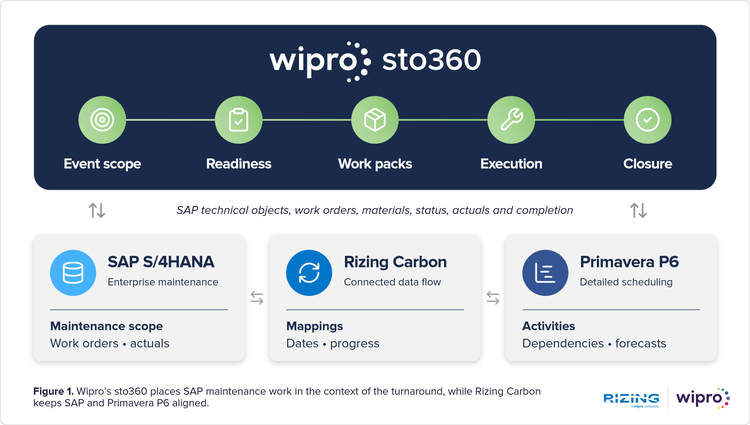
From Scope Change To Controlled Execution
With the connected flow in place, the turnaround team can assess the change as one end-to-end scenario rather than a series of disconnected updates:
- The maintenance requirement and formal work record are created or updated in SAP S/4HANA.
- Wipro’s sto360 places that work within the turnaround event, linking it to scope, work-pack readiness, approvals and outstanding actions.
- Rizing Carbon transfers relevant work information from SAP into Primavera P6 for detailed scheduling.
- P6 planners assess dependencies, resources, dates and critical-path impact.
- Relevant schedule and progress information then flow back to help keep SAP and Primavera P6 aligned.
- The turnaround team gains a wider execution picture that combines SAP work status with readiness, actions, quality, safety and closure activities.
The Value Is Not Another System View
The value comes from connecting decisions across the lifecycle. SAP S/4HANA continues to manage enterprise maintenance, while Primavera P6 supports detailed scheduling. Rizing Carbon keeps information aligned between these environments, and Wipro’s sto360 provides the event-level context needed to coordinate scope, readiness, execution and closure.
For the additional scope identified six weeks before execution, that means less time reconciling records and greater confidence that agreed changes are reflected across the relevant teams and systems.
Connected Information Supports Better Turnaround Decisions
Turnaround performance depends on more than the quality of information held in individual systems. It depends on whether teams can understand the impact of a change across scope, readiness, maintenance execution and the detailed schedule.
When information flows consistently across scope, readiness, maintenance execution and detailed scheduling, teams can spend less time reconciling records and more time managing the decisions that affect execution.
The result is not simply better system integration. It is a more coordinated approach to controlling change throughout the turnaround lifecycle.
Strengthen Decision-Making Across Your Turnaround Lifecycle
Connect with the Wipro Rizing EAM experts to explore how a more connected approach can reduce manual reconciliation, improve information consistency and support coordinated turnaround execution.
About the Authors
Raliza Abd Karim
Rizing Carbon Product Owner
Katta Mohan Reddy
Wipro sto360 Product Lead