

Simplifying Fashion and Retail Returns with SAP S/4HANA Advanced Returns Management
Returns may appear straightforward from the customer’s perspective, but for retailers they can quickly become costly and complex. Every return has a commercial consequence, affecting customer experience, inventory availability, working capital and ultimately the margin retained from the original sale.
The challenge is particularly relevant in fashion and apparel. Flexible return policies give consumers greater confidence to explore size, fit and style, but that convenience also increases the volume of merchandise flowing back through the retail network.
Why fashion and retail returns become complex
Behind every return is a chain of activities spanning stores, e-commerce, warehouses, customer service, logistics partners, suppliers and finance. Keeping these activities synchronized is essential to connecting customer resolution, inventory recovery and financial settlement. For fashion and retail leaders, the issue is how to coordinate the decisions surrounding each return without introducing unnecessary cost, delay or operational complexity.
For businesses running older or highly customized SAP ERP environments, returns may be handled through separate processes, with manual intervention required at different stages. The result can be a fragmented returns journey that increases processing effort, delays customer refunds, and limits end-to-end visibility.
Some of the challenges we have seen include:
- Fragmented processes across return initiation, inspection, logistics and settlement
- Limited visibility across the end-to-end returns journey
- Delays and limited flexibility in customer compensation
- Integration gaps across warehouses, suppliers, carriers and third-party applications
- Complex inspection and logistical follow-up
- Difficulty supporting omnichannel, B2B and non-standard return scenarios
This raises broader operating-model questions: When should compensation be issued? When should returned inventory become available again? How should exceptions be controlled? And when should a supplier or external partner become involved?
Orchestrating the returns journey with SAP S/4HANA Advanced Returns Management (ARM)
Addressing this complexity requires retailers to coordinate the decisions, product movements, and financial processes triggered by a return, while retaining the flexibility to manage different products, channels, locations, and outcomes.
SAP S/4HANA Advanced Returns Management (ARM) provides a connected approach by bringing these activities together across the end-to-end returns process. Rather than treating each return as an isolated transaction, SAP S/4HANA ARM links the product’s physical journey with the customer’s compensation, the product’s return to available inventory, and the final financial settlement.
At the center of this process is the Advanced Returns Order, which coordinates the return and its subsequent activities. This creates a common foundation for decisions that might otherwise remain distributed across stores, distribution centers, suppliers, customer service, logistics, and finance.
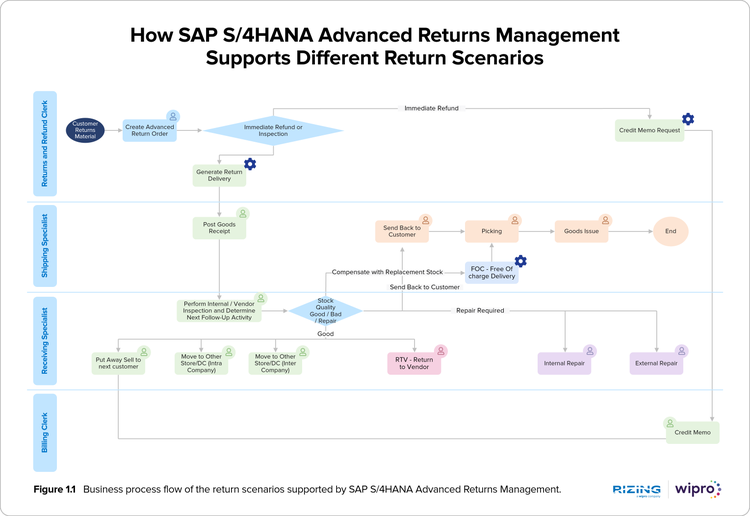
Typically, how a return is handled depends on the product’s condition, the location at which it is received, and the logistical or financial action required. SAP S/4HANA Advanced Returns Management brings these variables into a structured process and supports a range of return scenarios, as shown in Figure 1.1, including:
- Return to stock: Inspect and restore saleable merchandise to inventory.
- Move to another location: Transfer merchandise to the original or another store or distribution center.
- Return to vendor: Route merchandise back to the supplier and process the related credits.
- Direct drop-shipment return: Allow the customer to return merchandise directly to the vendor.
- Customer-site return: Inspect the product at the customer’s location.
- Return without refund: Return the inspected product to the customer when compensation is not approved.
- Free-of-charge (FOC) replacement: Compensate the customer with a replacement item at no additional cost.
- Repair: Route the product for internal or external repair.
From fragmented returns to a connected fashion and retail process: A real-world example of SAP S/4HANA Advanced Returns Management
For one client, returns management spanned B2B, retail, and e-commerce operations. The process required coordination across customer, supplier, and stock-transfer returns, as well as internal teams, external partners, and connected applications.
SAP S/4HANA Advanced Returns Management provided the structured framework to bring these activities together, centered on the Advanced Returns Order, which controls the downstream returns process.
The implementation addressed several key areas:
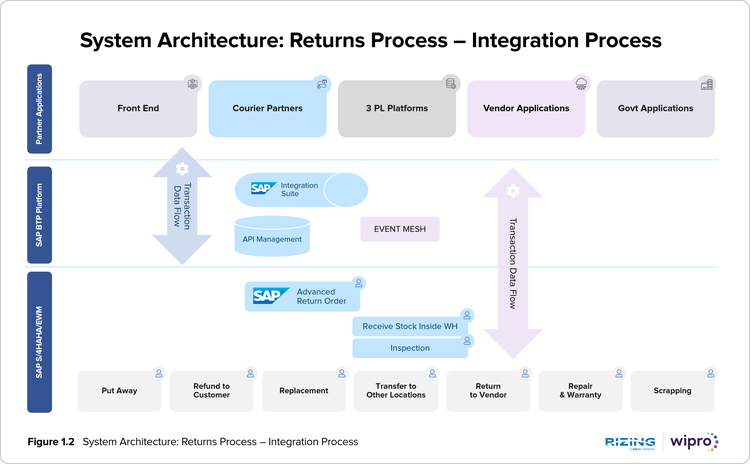
Connecting the returns ecosystem: SAP S/4HANA ARM APIs connected the process with courier aggregators, last-mile delivery applications, government applications, third-party logistics providers, and external vendors. Standard APIs also supported vendor notification and inspection for high-value items.
Coordinating inspection and product movement: Integration with SAP Extended Warehouse Management supported the movement of returned products from goods receipt to quality inspection. Based on the inspection outcome, logistical follow-up activities defined in SAP S/4HANA was triggered from SAP EWM.
Improving control and visibility: SAP Event Mesh provided updates to consuming applications, while the Manage Customer Returns SAP Fiori app gave teams visibility into quality checks, refund determination, and overall return status.
Managing resolution and repair: The solution supported compensation immediately after the return order was saved, after inspection, or after supplier compensation. Integration with the service module also supported internal and external repairs for in-warranty and out-of-warranty scenarios.
Business value of SAP S/4HANA Advanced Returns Management
By connecting activities across the return lifecycle, SAP S/4HANA ARM gives retailers greater control over how returns are processed, when customers are compensated, when products can re-enter available inventory, and how the related financial transactions are managed. Together, these capabilities create value across four key areas:
01. Reduce manual effort across the returns lifecycle
Automating follow-up documents and connecting customer, supplier, and stock-transfer returns reduces repetitive work, handoffs, and processing errors. Integration with SAP Finance also keeps credit memos, intercompany billing, and settlement aligned with the physical return, reducing the effort needed to reconcile transactions later.
02. Resolve returns faster with greater control
SAP S/4HANA ARM can shorten the path from return initiation to compensation by coordinating inspection, refund determination, and credit processing. Retailers can control whether a refund is issued immediately, after inspection, or after supplier compensation. This helps customers receive a timely resolution while allowing the business to apply the right level of control for the product and return scenario.
Integration with SAP Quality Management helps align the refund with the product’s actual condition, supporting fairer and more consistent decisions. SAP CRM complaints processing can connect the complaint, return, and refund journey, while e-commerce support gives customers a guided way to initiate and track their return.
Together, these capabilities can reduce avoidable delays, give customers greater transparency, and help service teams resolve enquiries with more consistent information.
03. Improve visibility from return to resolution
The returns overview provides a real-time view of follow-up documents, logistical processing, and refund status, helping teams monitor progress, identify delays, and respond to customer enquiries. This visibility also supports faster disposition decisions, reducing the time merchandise remains unavailable and improving the opportunity to return saleable products to stock before further markdowns are required.
04. Manage complex return scenarios without manual processes
SAP S/4HANA ARM extends beyond traditional lean returns to support scenarios including sales kits, free-of-charge goods, make-to-order goods, non-stock materials, third-party returns and intercompany returns.
As return volumes, channels, and fulfilment models grow, retailers can support more scenarios through a common process instead of adding separate workflows and manual workarounds. This helps the returns operating model scale without increasing complexity at the same rate.
Getting fashion and retail returns right is an operating-model decision
Returns will remain part of fashion and retail, particularly as businesses operate across more channels, fulfilment models and customer touchpoints. The opportunity SAP S/4HANA ARM presents is bringing the decisions around inspection, customer compensation, inventory and financial settlement together within one connected process.
For fashion and retail leaders, this shifts the conversation from managing returns as an exception to making them an integral part of the operating model, while retaining the flexibility to determine the right outcome for different return scenarios.
If your current returns process is becoming harder to manage as the business grows across channels and fulfilment models, it may be time to take a closer look at where the complexity sits. Talk to us about the role SAP S/4HANA Advanced Returns Management could play in building a more connected approach to returns.
Frequently Asked Questions
-
What is SAP S/4HANA Advanced Returns Management for fashion and retail businesses?
SAP S/4HANA Advanced Returns Management (ARM) is embedded within SAP S/4HANA and provides a structured, integrated framework for managing customer, supplier and stock-transfer returns. For fashion and retail businesses, ARM can help coordinate returns across stores, distribution centers and other fulfilment paths, connecting activities such as goods receipt, inspection, logistical follow-up, refund determination and replacement or credit processing. -
How does SAP S/4HANA Advanced Returns Management manage complex return scenarios for fashion and retail businesses?
In an omnichannel fashion and retail environment, returns can move through stores, distribution centers or suppliers, with different requirements for inspection, refund and follow-up processing. SAP S/4HANA Advanced Returns Management helps manage this complexity by bringing different return scenarios into an integrated process, with follow-up actions determined by the requirements and outcome of each return. -
What is the difference between traditional SAP returns processing and Advanced Returns Management?
Traditional SAP returns processing can involve separate processes for customers, supplier and stock-transfer returns, with more manual handling across document flows and tracking. SAP S/4HANA Advanced Returns Management brings these return types into a more unified, integrated process with automated follow-up document generation and centralized tracking through applications such as Manage Customer Returns.