

Retail Lifecycle Pricing: How Retailers Can Improve Pricing Decisions from Strategy to Execution
For retailers, the difficult part of pricing is no longer simply setting a price. It is making the right pricing decision, at the right point in the product lifecycle, while balancing margin, demand, inventory, competitive pressure and customer price perception.
Consider these common pricing scenarios: a new product enters the assortment, a vendor changes its cost, or a competitor moves its price. Each scenario can trigger a pricing decision with implications that extend beyond the price itself.
Yet those decisions are rarely isolated. Merchants and pricing teams need to connect everyday pricing, new-item pricing, competitive responses and markdowns with the wider pricing strategy, while accounting for business rules, product relationships, price zones and changing market signals.
That makes the pricing challenge bigger than finding the "right" price. The challenge is creating a repeatable, governed way to move from strategy through analysis and optimization to execution across every sales channel.
The Cost of Disconnected Pricing: Why Do Retailers Struggle to Execute Pricing Strategy Across Channels?
Pricing decisions often require input from merchandising, pricing, finance, inventory, store operations and IT teams. When the information supporting those decisions is spread across teams, systems and processes, merchants can spend more time gathering and reconciling data than evaluating opportunities and risks.
Disconnected retail pricing can lead to:
- Inconsistent application of pricing strategies and rules
- Heavy reliance on spreadsheets and manual analysis
- Slower responses to competitor and vendor cost changes
- Limited visibility into financial, demand and inventory impacts
- Pricing decisions that overlook product relationships or broader business constraints
- Additional effort to execute approved prices across systems and channels
When strategy, analysis, approval and execution operate as separate activities, maintaining pricing discipline becomes more difficult as the number of products, locations and decisions grows. Retailers therefore need to manage pricing as an end-to-end business capability rather than a series of isolated price changes.
What Is Retail Lifecycle Pricing and How Does It Work?
Retail lifecycle pricing is the practice of managing pricing decisions across every stage of a product’s life from its initial introduction through everyday management, competitive response and eventual markdown or exit.
Rather than treating each decision separately, it connects them through shared data, rules, decision processes and workflows.
Rizing Retail LifeCycle Pricing applies this approach by turning pricing strategy into actionable decisions and controlled execution. Built as a cloud-based SAP Fiori application on SAP Business Technology Platform, it connects with SAP S/4HANA Retail Cloud ERP and SAP Customer Activity Repository to bring the data, insights and workflows retailers need into one decision-making experience.
The solution supports four core pricing scenarios:
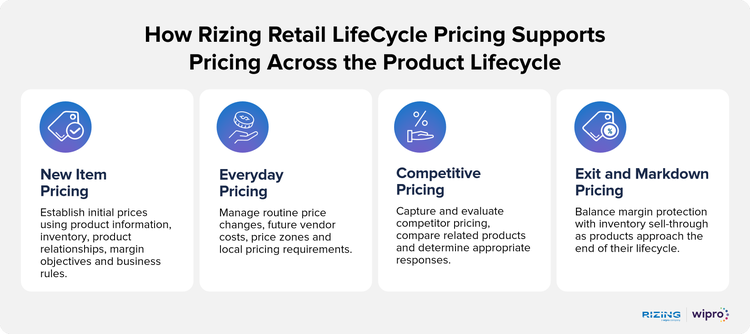
Together, these scenarios provide a framework for managing pricing from product introduction through everyday decisions and eventual exit.
Four Stages to Turn Retail Pricing Strategy into Action
Whether a retailer is setting the price of a new item, responding to a competitor, managing a cost change or planning a markdown, the decision follows the same fundamental journey. Rizing Retail LifeCycle Pricing connects that journey through four stages:
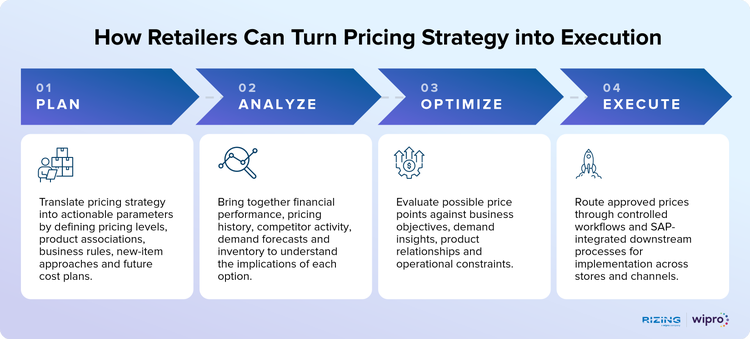
Together, these stages create a clearer line of sight from the original pricing objective to execution. Teams can better understand what informed a pricing decision and how it moved through the decision process.
What Capabilities Do Retailers Need to Manage Retail Pricing Across Channels?
The four stages describe the pricing decision process. Putting that process into practice requires capabilities that establish pricing rules, bring relevant information into each decision, evaluate alternatives and support execution.
Rizing Retail LifeCycle Pricing brings these capabilities together across six core areas.
01. Price Rules Management: Turn Strategy into Repeatable Rules
Pricing strategy is difficult to scale when rules are spread across spreadsheets, teams, products and locations.
How Rizing Retail LifeCycle Pricing helps: A centralized rules engine helps consistently apply pricing strategies across products and locations. Rules can incorporate price zones, margins, competitor relationships, product strategies, rounding, ending numbers and other business requirements.
Product associations including Key Value Items, Good-Better-Best relationships, Price Families and Size Groups help teams manage pricing across the assortment rather than treating every item as an isolated decision. This gives merchants appropriate visibility and control while keeping decisions aligned with established pricing guardrails.
02. Competitive Shopping: Add Context to Competitor Prices
A competitor's price means little without context. Package sizes, units of measure, brands and relationships between products can make a simple price comparison misleading.
How Rizing Retail LifeCycle Pricing helps: Competitive Shopping supports the process from shop planning and price collection through product comparison and pricing decisions. Store personnel, price checkers or third parties can capture competitor observations, while price equalization helps compare products with different package sizes, units of measure, brands or related product structures.
03. Price Workbench: Bring Pricing Decisions into One View
Pricing decisions rarely depend on one piece of information. Merchants may need to consider products, locations, channels, price types and alternative pricing scenarios before acting. When that context sits across different applications, evaluating the decision becomes more difficult.
How Rizing Retail LifeCycle Pricing helps: The Price Workbench gives merchants a centralized view of pricing across products, locations, channels and price types. Merchants can review supporting information, simulate alternatives and adjust proposed prices without moving between disconnected applications.
04. Pricing Event Simulator: Evaluate Events Before Prices Change
New products, vendor cost changes and optimization recommendations may require different decisions, but they share a common requirement: teams need a structured way to evaluate the event before changing the price.
How Rizing Retail LifeCycle Pricing helps: The Pricing Event Simulator provides a structured environment for recurring events such as new-item introductions, vendor cost changes and optimization reviews. Teams can bring together relevant information, evaluate alternatives and follow an established decision process before changing a price.
05. Advanced Pricing: Assess Alternatives Against Business Objectives
A pricing decision can have implications for revenue, margin, demand and inventory. The challenge for merchants is understanding those implications before a price reaches the market. That requires the ability to evaluate alternatives against financial objectives, demand signals and established business constraints.
How Rizing Retail LifeCycle Pricing helps: Advanced Pricing combines demand forecasting, simulation and optimization to evaluate alternative prices against financial and business objectives. Historical sales and consumer demand information support forecasting, while optimization evaluates recommendations against objectives such as revenue, margin, profitability, inventory movement and sell-through.
Optional AI-assisted capabilities can provide additional insight into complex product relationships, including substitution, cannibalization and halo effects.
The objective is not to replace merchant judgment, but to provide merchants with stronger decision support.
06. Markdown Pricing: Balance Sell-Through and Margin
Pricing objectives change throughout the product lifecycle. As products approach end of life, retailers need to weigh sell-through and inventory clearance against margin protection rather than treating markdown as simply another price reduction.
How Rizing Retail LifeCycle Pricing helps: Markdown Pricing helps retailers balance inventory clearance with margin protection. Configurable strategies, discount schedules, simulations and inventory tracking allow teams to evaluate approaches such as maximizing margin, achieving target sell-through or clearing inventory within a defined period.
Turn Your Retail Pricing Strategy into Governed Decisions and Repeatable Execution
For retail leaders, the value of lifecycle pricing is the ability to make pricing decisions within a consistent framework that reflects the retailer’s strategy, financial objectives, inventory position and competitive environment.
With Rizing Retail LifeCycle Pricing, that means connecting three priorities:
-
Apply Pricing Strategy Consistently at Scale
Translate pricing strategy into repeatable rules and guardrails across products and locations while accommodating appropriate category and local requirements. -
Keep the Business Impact in View
Bring pricing, margin, cost, demand, inventory and competitive information into the decision process so teams can evaluate alternatives in context before determining the appropriate course of action. -
Carry Decisions Through to Execution
Connect analysis, approvals and downstream processes so teams can follow how a pricing decision was made and how it is applied across the business.
Build a More Connected Pricing Process
Every retailer has its own mix of pricing strategies, financial objectives, competitive pressures and technology requirements. The opportunity is to identify where connecting those decisions more effectively could have the greatest impact on the business.
See how Rizing Retail LifeCycle Pricing can support your retail pricing priorities.
Frequently Asked Questions
What is the difference between retail lifecycle pricing and retail price optimization?
Retail price optimization uses demand forecasting, simulation and optimization techniques to evaluate prices against financial and business objectives. Retail lifecycle pricing is broader, connecting optimization with the other pricing decisions retailers make as products move from introduction through everyday management and eventual markdown.
Rizing Retail LifeCycle Pricing brings these decisions into a connected pricing environment. Its capabilities span new-item pricing, everyday pricing, competitive pricing and markdowns, along with pricing rules, analysis, optimization, approval and execution.
How do retailers manage pricing across the product lifecycle?
Retailers manage pricing across key stages of a product's lifecycle, including setting an initial price, managing everyday price changes and vendor costs, responding to competitive activity, and adjusting markdowns as products approach end-of-life. Connecting these decisions through shared rules, data and governance can help create a more consistent approach.
Rizing Retail LifeCycle Pricing supports four key retail pricing scenarios: New Item Pricing, Everyday Pricing, Competitive Pricing, and Exit and Markdown Pricing. Together, these provide a framework for managing pricing from product introduction through everyday management and eventual exit.
What should retailers look for in a retail pricing platform?
Retailers should consider capabilities such as centralized pricing rules, competitor price comparison, visibility across products and channels, demand forecasting, simulation and optimization, markdown management, workflow, and integration with their existing retail environment.
Rizing Retail LifeCycle Pricing integrates with SAP S/4HANA Retail Cloud ERP to bring these capabilities together, spanning Price Rules Management, Competitive Shopping, Price Workbench, Pricing Event Simulator, Advanced Pricing and Markdown Pricing.